


Highlights
Industry:
AdTech and mobile advertising
Project scope:
- Build a centralized mobile ad mediation and yield optimization platform
- Manage ad network priorities and route traffic across multiple demand sources
- Add OpenRTB support, monitoring, statistics, and operational controls
The Client
Game developmentA mobile game developer and publisher with a portfolio of products used by players around the world. The company monetizes its apps through advertising and works with multiple ad networks across different platforms and geographic markets.
The Project
As the number of apps, advertising partners, regions, SDK versions, and ad formats grew, managing mobile advertising became increasingly complex. The client needed a mobile ad mediation platform that could control demand sources, network priorities, and advertising traffic from one place.
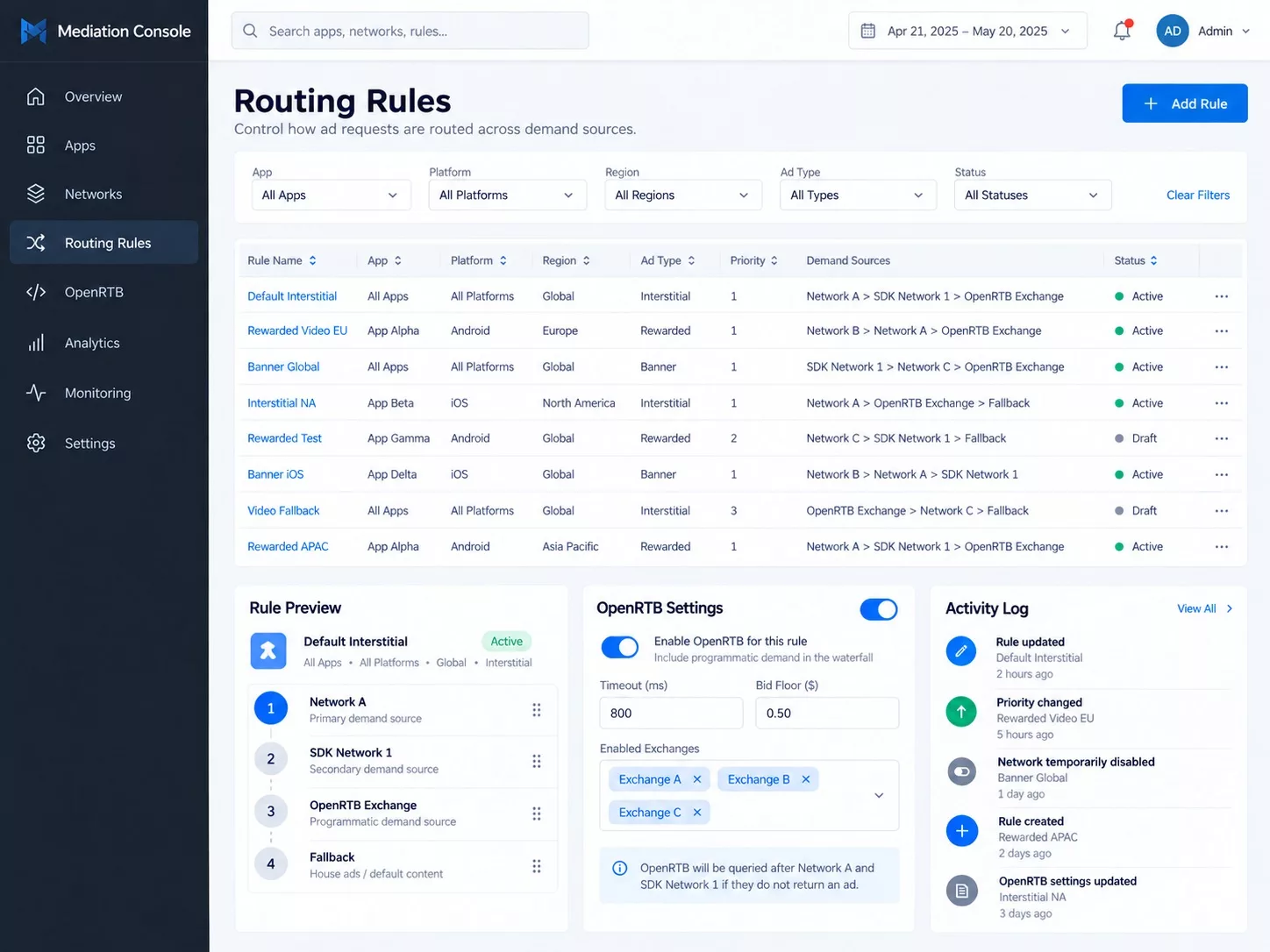
XIM developed a centralized platform that acted as a layer between the client’s mobile apps and multiple advertising networks. For each ad request, the system used information such as the app, platform, app version, device parameters, location, and ad type to decide which networks should be used and in what order.
The platform also had to support different integration models. Some advertising demand was handled on the server side, while SDK-based networks were called directly from the mobile app. Both approaches had to work through the same management layer. The platform was later extended with OpenRTB support, allowing programmatic demand to work alongside traditional ad network integrations.
Project duration:
12 months
Project team:
3 specialists
Project labor costs:
12 person-months
Technology stack:
Java, Hibernate/JPA, JavaScript, HTML, Play Framework, Erlang, MySQL, Memcached, FreeBSD, OpenRTB
1/2
The Solution
Mobile ad mediation platform
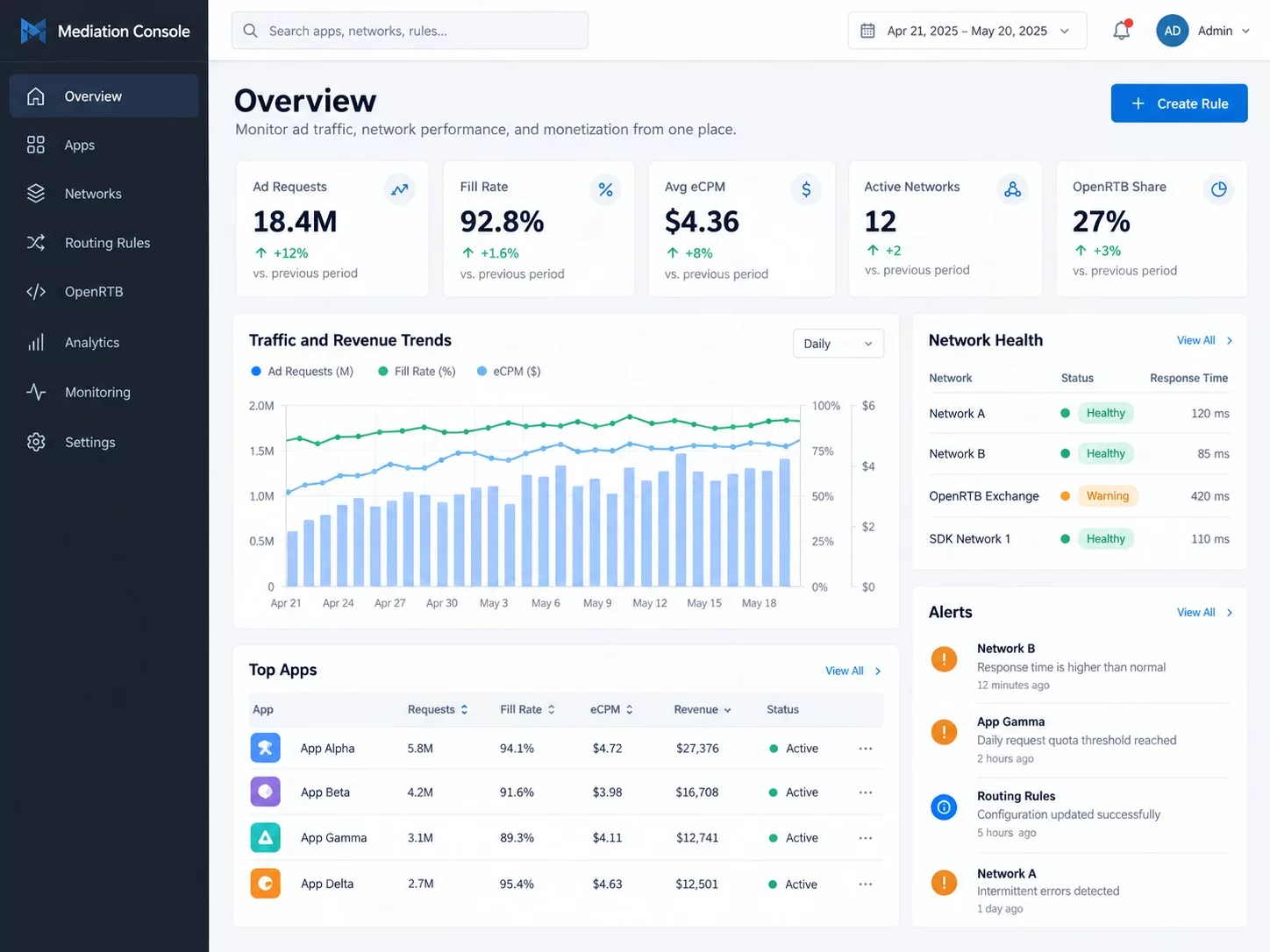
XIM built a centralized mobile ad mediation platform that gave the client one place to manage advertising traffic across apps, platforms, regions, SDK versions, ad formats, and demand sources. Operators could configure ad network connections and priorities centrally, making it easier to add new networks, change monetization rules, and manage available ad inventory without hardcoding this logic into individual mobile apps.
Dynamic ad routing and OpenRTB
For each ad request, the platform checked the relevant parameters and selected the right demand sources and their priority. It supported both server-side mediation and SDK-based routing, while OpenRTB integration allowed RTB demand to participate alongside traditional ad networks. The routing logic also handled networks that were slow or temporarily unavailable, helping keep ad delivery stable.
Monitoring and operational control
The platform included tools for keeping the advertising infrastructure reliable as the number of networks and configurations grew. It tracked network response times, applied quotas, and could automatically disable poorly responding networks, while technical teams had access to statistics, application errors, real-time traffic tracing, and logs of important configuration changes.
The Outcome
XIM delivered a mobile ad mediation platform that allowed the client to manage advertising demand across multiple apps, platforms, markets, and ad networks from one system.
Instead of keeping network priorities and monetization rules inside individual mobile applications, the client could manage them centrally and update configurations dynamically. This made the advertising setup easier to maintain and gave the team more control over how available ad inventory was monetized.
The platform brought together ad mediation, dynamic network prioritization, server-side and SDK-based integrations, OpenRTB, monitoring, statistics, logging, and real-time traffic tracing. It also created a flexible foundation for adding new demand sources, supporting more ad formats, and moving toward more advanced programmatic advertising models.